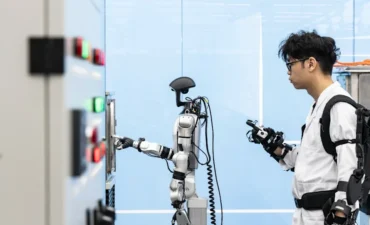
This week’s stories are about tech, AI and sustainability, coming from Germany, Netherlands and the UK
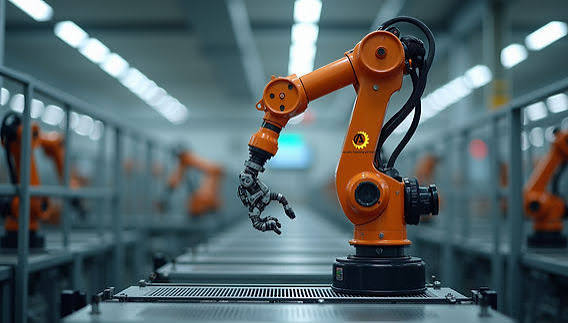
5 million robots operate in factories worldwide
The number of robots operating in factories worldwide rose 9% to 5 million, more than double the total recorded seven years earlier, the IFR said in its World Robotics 2026 report.
China accounted for 59% of new industrial robot installations worldwide in 2025, as global factory robot deployments reached a record 603,000, according to the International Federation of Robotics.
China installed 354,000 industrial robots last year, a 20% increase from 2024. Chinese manufacturers supplied 195,000 of those units, giving them a 55% share of the domestic market, down from 57% a year earlier.
Electronics companies were the largest buyers, installing 96,400 robots. Automotive manufacturers deployed 78,900, up 38%, while the metal and machinery industries installed 78,700, a 44% increase.
Robot installations in food and beverage sector fell 37%, while textile industry installations plunged 92%.
The United States installed 38,400 industrial robots in 2025, an increase of 12%, overtaking Japan to become the world’s second-largest robot market.
Japan’s installations fell 19% to 36,219, the country’s lowest level in a decade. South Korea remained the fourth-largest market with about 30,000 installations, while India ranked sixth with nearly 10,500 units.
The European Union installed 60,500 new industrial robots in 2025, down 11% from the previous year. By comparison, installations in Asia increased 14% to 457,315, while those in the Americas rose 14% to 57,044.
Despite the decline in annual installations, the number of robots operating in EU factories surpassed 700,000 for the first time, reaching 712,000. That is more than 80% higher than in 2015.
Humanoid robots remain a relatively small segment of the industrial robotics market. The IFR said about 7,000 full-size humanoid robots, standing more than 140 centimeters tall, were sold worldwide in 2025.
5 million robots operate in factories worldwide
Germany and Netherlands to collaborate on AI chip design
Germany and the Netherlands are joining forces to develop new approaches to artificial intelligence (AI) chip design, committing a combined 40 million euros ($47 million) to a 20-month project as Europe seeks to reduce its dependence on U.S. and Chinese technology. (By the way I have a story here about Germany)
I read this story at Reuters and the project will bring together the Dutch National Agency for Disruptive Innovation, known as NADI, and Germany’s Federal Agency for Disruptive Innovation, SPRIND, Dutch Prime Minister Rob Jetten said.
The Dutch government allocated 500 million Euros last month to establish NADI, which is modeled in part on the U.S. Defense Advanced Research Projects Agency, or DARPA.
Jetten has made NADI one of the initiatives aimed at strengthening the Netherlands’ competitiveness and noted European countries need to cooperate across borders rather than pursue innovation independently.
NADI co-founder Jelle Prins underlined chip design was a natural focus because of the Netherlands’ semiconductor ecosystem, including equipment maker ASML, while Germany brings significant research and manufacturing capabilities to the partnership.
Under the project, small teams will use AI to accelerate the development of chips designed for training AI models and for inference, the process of running trained models, the story claimed.
Prins said Nvidia’s chips offer high performance but can be inefficient for inference workloads.
Jano Costard, head of challenges at SPRIND, said the partners aim to use AI to accelerate chip-design processes that currently can take years by several orders of magnitude.
Several European countries have established agencies focused on high-risk innovation in recent years. France launched its defense innovation agency AID in 2018, Germany established SPRIND in 2019 and Britain created the Advanced Research and Invention Agency, known as ARIA, in 2023.

Germany and Netherlands to collaborate on AI chip design
“Turn the cameras off”: London pushes back against smart glasses
The growing use of camera- and microphone-equipped smart glasses is fueling privacy concerns in London’s bars, restaurants and theaters, with some businesses restricting their use amid fears that people could be recorded without their knowledge.
Sales of AI-enabled smart glasses reached 7 million units worldwide in 2025, according to wearable technology company EssilorLuxottica.
The technology has also prompted concerns about people being photographed or recorded without realizing it. I read this story at the CNN and videos shared on social media that appear to show women being filmed without their knowledge intensified debate over consent and whether existing privacy laws can keep pace with increasingly discreet recording technology.
London has emerged as one of several cities and markets where businesses and the public are grappling with how to respond to the devices, alongside New York and Australia.
British pub chain Wetherspoons banned customers from recording with smart glasses, citing concerns about people being filmed without their knowledge.
Meta, whose smart glasses are developed in partnership with EssilorLuxottica, says its devices have an indicator light that comes on when the camera is recording. The company says the camera will not record if the light is covered.
But privacy experts say technical safeguards may not fully resolve the risks.
Calli Schroeder, Director of the AI and Human Rights program at the Electronic Privacy Information Center, noted potential measures such as automatically blurring the faces of people captured on camera or requiring consent before videos can be uploaded would be difficult to implement and would not eliminate all privacy concerns.

“Turn the cameras off”: London pushes back against smart glasses