
This week’s stories are about tech, AI and sustainability, coming from Japan, the UK and the USA
AI boom brings more than 50 new billionaires in 2025
Explosive growth in artificial intelligence (AI) helped create more than 50 new billionaires in 2025, as record investment, soaring valuations and intense competition across the industry reshaped global wealth.
Investors poured more than $200 billion into AI companies in 2025 with startups capturing about half of all global venture funding, up sharply from 2024, data from Crunchbase reveals.
Momentum intensified early in the year after Chinese startup DeepSeek released an open-source AI model trained with far less computing power than its U.S. rivals. The development rattled markets and propelled founder Liang Wenfeng into the billionaire ranks, with an estimated net worth of $11.5 billion. (By the way I have a story here about AI)
U.S.-based Anthropic also surged, raising billions of dollars at ever-higher valuations. By September, the maker of the Claude AI model was valued at about $183 billion, lifting all seven of its cofounders to billionaire status.
Competition for AI talent also intensified. In June, Meta bought a 49% stake in data-labeling company Scale AI for more than $14 billion. The deal valued Scale at roughly $29 billion and briefly made cofounder Lucy Guo the world’s youngest self-made woman billionaire. Scale CEO Alexandr Wang joined Meta as its chief AI officer as part of the agreement.
Other data-labeling startups also benefited. Surge AI, which serves major technology companies and AI labs, reached an estimated valuation of $24 billion, making founder Edwin Chen the wealthiest newcomer among 2025’s AI billionaires. Mercor, another data-labeling firm, achieved a $10 billion valuation in October, turning its three 22-year-old cofounders into the youngest self-made billionaires on record.
Startups working on AI-generated audio, video and images drew billions in funding, including ElevenLabs, whose cofounders became billionaires after a funding round valued the company at $6.6 billion.

AI boom brings more than 50 new billionaires in 2025 (Photo: Forbes)
A year after unveiling ambitious AI strategy, UK faces hurdles in infrastructure rollout
Nearly a year after the British government launched an ambitious plan to turn the United Kingdom into an “AI superpower,” major investments from global technology companies signal progress, but persistent energy constraints and slow infrastructure development threaten to hold the country back.
I read this story at Cnbc and Prime Minister Keir Starmer announced the AI Opportunities Action Plan in January, outlining a strategy to deploy artificial intelligence (AI) across the economy. A central pillar of the plan was a rapid expansion of data centers to meet AI’s heavy computing demands, supported by so-called “AI growth zones” offering relaxed planning rules and improved access to power.
Since then, companies including Nvidia, Microsoft and Google have pledged billions of dollars toward AI infrastructure in the U.K. Four AI growth zones have been designated, and domestic firms such as data center developer Nscale have emerged as key players.
Most AI growth zones remain in early stages. The first site, announced in Oxfordshire in February, has yet to begin construction. Preparatory work has started at a site in northeast England, with full building expected in early 2026. Two additional zones in north and south Wales were announced in November, with one still seeking an investment partner and the other consisting of multiple sites at varying stages of operation, according to the Department for Science, Technology and Innovation.
The government has said it aims for AI growth zones capable of serving at least 500 megawatts of demand by 2030, with one zone scaling beyond one gigawatt.
AI adoption is also increasing overall energy demand, placing further strain on an already stretched power system, according to the story.
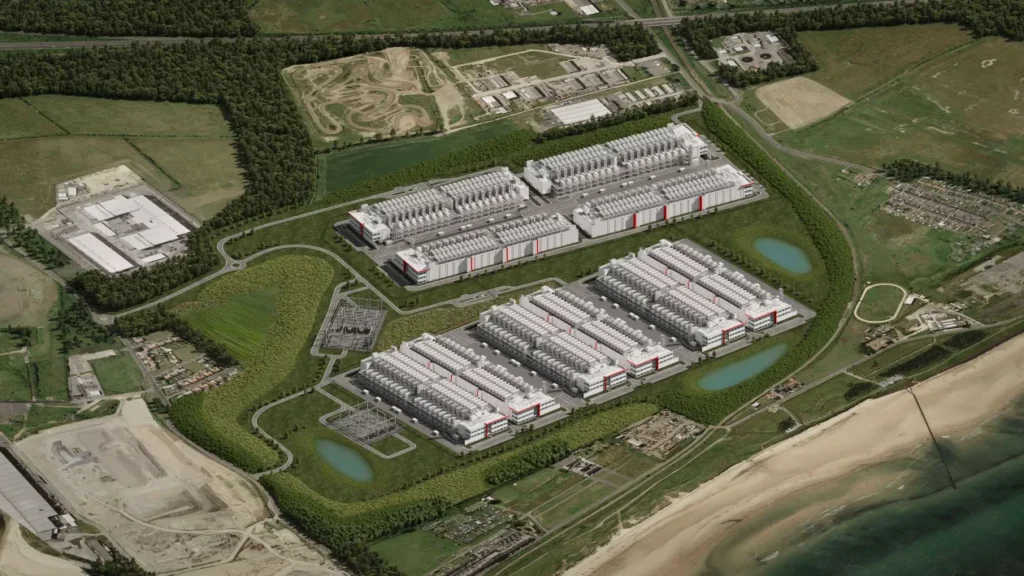
QTS’s data center in Cambois, North East of England (Photo: CNBC)
Japan introduces $1.34 billion subsidy program to boost clean energy demand
Japan will launch a 210 billion yen ($1.34 billion) subsidy program over five years to encourage companies to invest in facilities powered entirely by decarbonized electricity, as the government seeks to accelerate renewable energy use while supporting regional economic growth.
I saw this story at ESGnews and the plan, announced by the Ministry of Economy, Trade and Industry, will subsidize up to 50% of capital investment costs for eligible companies that commit to using fully carbon-free power and contribute to local economies where the electricity is produced. Data center operators will also qualify under the same criteria. (By the way I have a story here about Japan and it registers the design of Turkey’s domestic car)
The subsidy program will begin in fiscal 2026 and run for five years. Applications from companies are expected to open in the next fiscal year, giving businesses early guidance on investment planning, said Juntaro Shimizu, director of the Green Transformation policy group at the ministry.
Japan has set a goal for renewable energy to supply up to 50% of its electricity by fiscal 2040, with nuclear power accounting for an additional 20%. In fiscal 2023, renewables made up 22.9% of electricity generation, while nuclear contributed 8.5%, per the story.
Progress toward those targets has slowed amid rising costs and delays in offshore wind projects, as well as local opposition to large-scale solar developments. The new subsidy framework is designed to stimulate demand for clean power, even as supply-side challenges persist, the story noted.
The measures fall under Japan’s GX 2040 vision, a national strategy approved earlier this year that integrates climate policy with industrial development. The government plans to establish designated “GX Strategy Regions” to promote industrial clusters in areas with access to decarbonized electricity, supported by subsidies and regulatory reforms.

Japan introduces $1.34 billion subsidy program to boost clean energy demand