
This week’s stories are about tech, sustainability and AI, coming from Japan, Taiwan, the Netherlands and South Africa
Sony, TSMC to form $5 billion image sensor JV
Sony’s semiconductor unit and Taiwan Semiconductor Manufacturing Co. have signed a binding agreement to establish a $4.7 billion joint venture (JV) focused on developing and manufacturing image sensors for smartphones.
The JV, Advanced Vision Semiconductor Manufacturing, is expected to begin mass production in 2029, subject to regulatory approvals and the completion of other closing conditions..
I saw this story at Mobile World Live and the agreement follows a memorandum of understanding signed by the companies in May. Sony will control the new venture, which will operate as a subsidiary of the Japanese technology company, the story said.
Sony will lead the development of core image sensor technologies as well as product planning and design. TSMC will contribute its expertise in advanced semiconductor manufacturing processes and production technology, per the story.
The companies announced the partnership is intended to support the development and manufacturing capabilities needed for high-volume image sensor production.
Sony plans to contribute 465 billion yen (about $2.9 billion) to the JV through a combination of cash and a manufacturing facility in Koshi, Japan. TSMC will provide 282 billion yen (about $1.8 billion) in cash.
The companies are also considering additional sources of financing to reach their targeted production capacity, alongside their initial contributions. The funding plan assumes support from the Japanese government, according to the story.
The joint venture will begin operations only after regulatory approvals and other required closing conditions have been met.

Sony, TSMC to form $5 billion image sensor JV
Chinese automakers turn to Africa as EV production expands beyond China
Chinese automakers are increasingly moving from exporting vehicles to manufacturing them in Africa, betting that rapid urbanization, a growing middle class and government support for electric vehicles will make the continent a major growth market for the industry.
I read this story at The Associated Press and the shift comes as demand for cars in China slows and trade barriers rise in Europe and North America. Analysts say expanding production in Africa could create jobs, strengthen local supply chains and accelerate the adoption of electric vehicles, although weak infrastructure and policy uncertainty remain major challenges.
Chery, China’s largest auto exporter, bought Nissan’s former Rosslyn plant near Pretoria, South Africa, in July. The company plans to produce plug-in hybrid and fully electric vehicles at the facility, along with models under its Jetour brand, per the story. (By the way I have a story here about China and Turkey)
The investment is part of a broader effort by Chinese automakers to manufacture closer to African consumers and reduce their reliance on vehicle imports. However, analysts say the trend remains in its early stages.
Other Chinese companies already have a manufacturing presence in South Africa. Beijing Automotive Group operates a vehicle manufacturing and assembly plant in Gqeberha, while Great Wall Motor has localized assembly and component distribution operations in the country, the story noted.
South Africa, Morocco, Kenya, Ethiopia and Ghana are among the African countries considered well positioned to attract Chinese EV investment, analysts say. Their advantages include existing industrial capacity, supportive government policies and improving electricity infrastructure.
Local production could also help lower vehicle prices by reducing import duties while encouraging investment in charging networks, component manufacturing and battery production, according to the story.
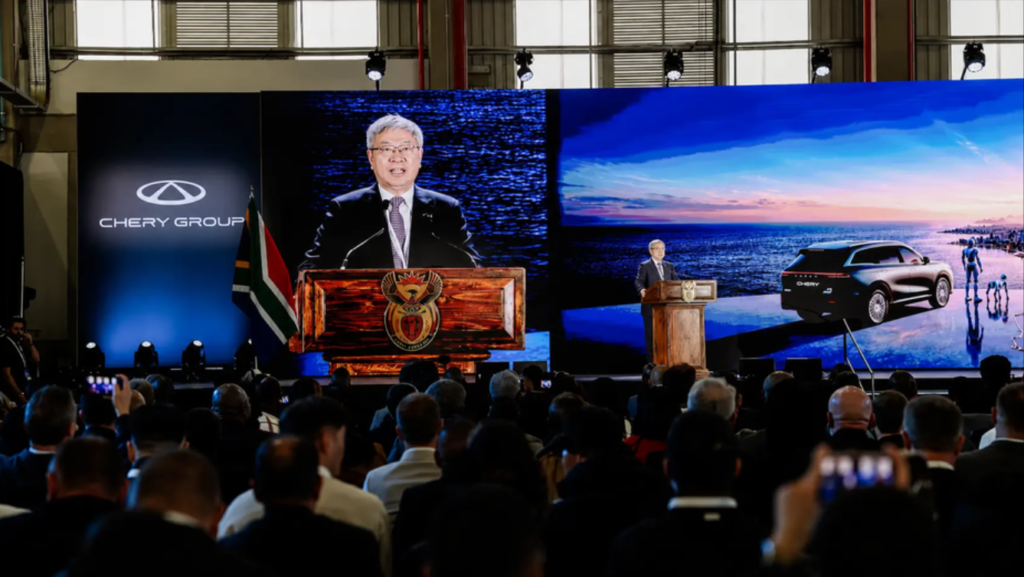
Chinese automakers turn to Africa as EV production expands beyond China
EU approves $335 million Dutch aid package for sustainable aviation fuel
The European Commission approved two Dutch state aid programs worth a combined $335 million to support the production of sustainable aviation fuel (SAF) and the development of new SAF projects in the Netherlands.
The funding will help finance investments in SAF production facilities as well as early-stage project work, including feasibility studies and engineering activities, the European Commission announced.
Projects receiving support are expected to have the capacity to produce about 285,000 metric tons of SAF annually. I read this story at ESG News and that output is equivalent to roughly 350 million liters of conventional kerosene and could provide fuel for about 3,500 long-haul flights, according to the Commission.
The programs are designed to support the European Union’s efforts to cut aviation emissions, as well as the goals of the European Commission’s Clean Industrial Deal and the ReFuelEU Aviation regulation, which aims to increase the use of sustainable fuels in aviation.
The two Dutch programs target different stages of SAF development. One will provide investment support for production facilities, while the other will finance preparatory work such as feasibility studies and front-end engineering.
Funding will be provided through direct grants after projects reach specified milestones. Applications will be assessed on a first-come, first-served basis, with the Commission requiring the process to remain objective, transparent and nondiscriminatory.
The programs are expected to operate from 2027 through 2031 at the latest.
The Netherlands plans to focus the funding on two SAF technologies that are considered less commercially mature.
One involves advanced biofuels that do not rely on the hydroprocessed esters and fatty acids, or HEFA, process widely used in aviation fuel production. The other is synthetic aviation fuel, commonly known as e-SAF, per the story.

EU approves $335 million Dutch aid package for sustainable aviation fuel